


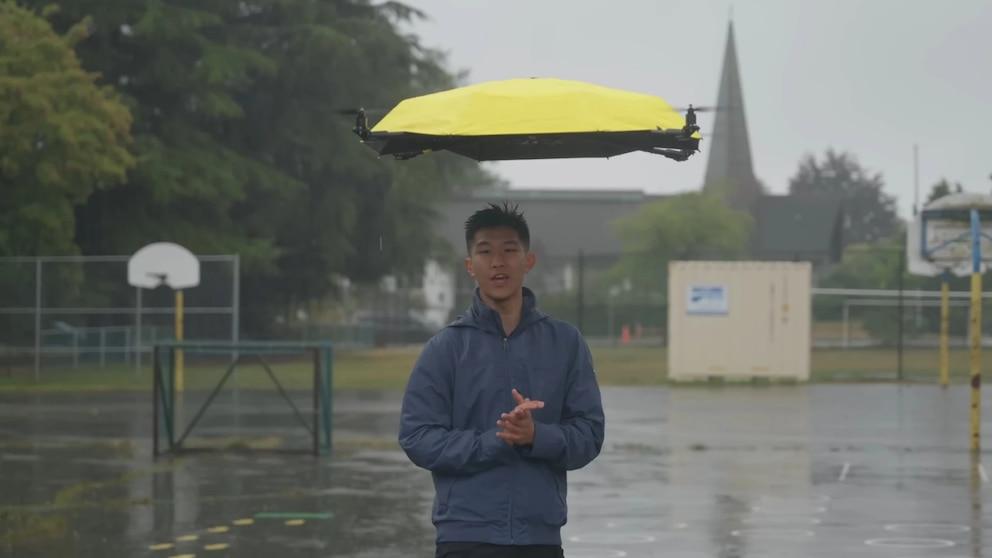
The challenge of keeping your hands free in the rain has led many inventors to look for alternatives to the traditional umbrella.One of the most striking projects emerged from the hand of John Xu, creator of the ‘I Build Stuff’ channel on YouTube, who has just presented an autonomous flying umbrella capable of following the user at all times, fusing everyday practicality with drone technology and advanced sensors.
John Xu debuted his first flying umbrella in 2024, using a self-made quadcopter drone to keep the umbrella suspended above the user’s head.
Although the image was striking and captured the attention of the channel’s followers, the invention had a key limitation: it required being controlled with a remote control.Thus, the supposed freedom of movement was overshadowed by the need to use both hands, adding complexity to a simple task.
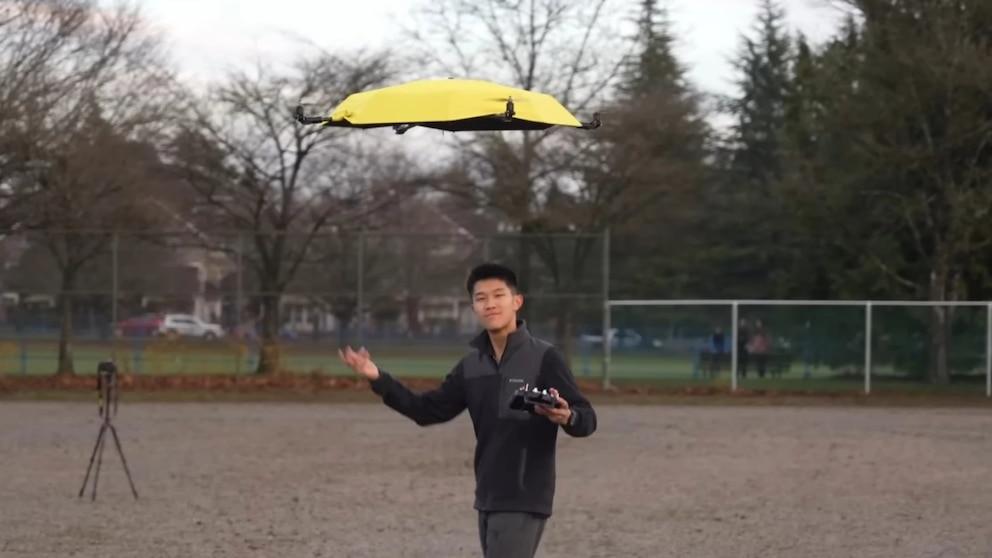
The reactions of the community were immediate.Comments on YouTube agreed that the concept was innovative but impractical, and many challenged Xu to create a version that did not depend on a manual controller.This challenge set the course of his work for the next two years.
Xu spent months redesigning the device, facing technical hurdles such as the accuracy of GPS tracking, which proved insufficient to track a person accurately.The goal of creating a folding umbrella and drone added mechanical difficulty to the process.
The solution came with the integration of a time-of-flight camera, which allowed the umbrella to identify and track the user directly, even in low light conditions.Although the system did not keep the umbrella perfectly centered at all times, the level of autonomy achieved transformed the experience and once again attracted the attention of the spectators.
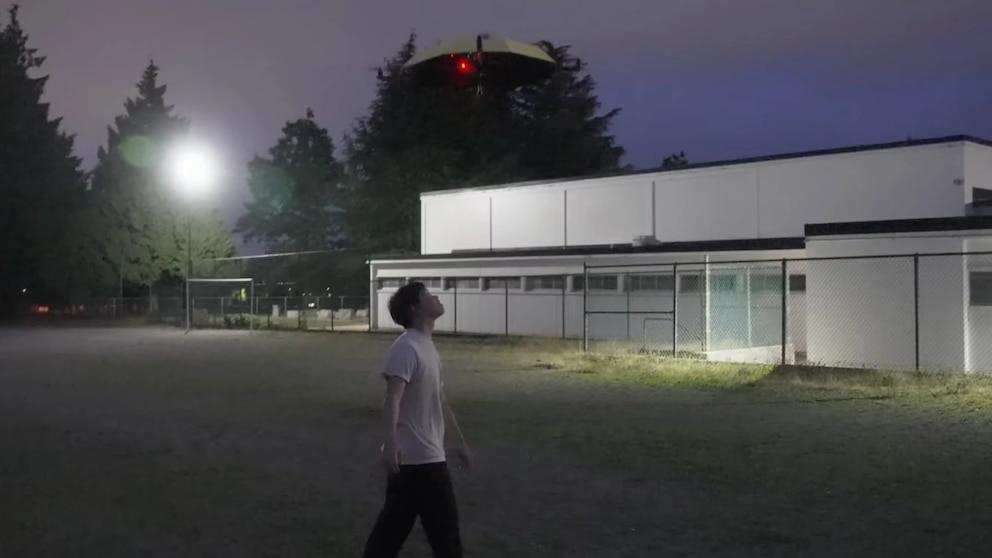
Xu’s flying umbrella raises questions about safety, feasibility, and social acceptance.Adverse weather conditions, such as strong wind or heavy rain, can destabilize the drone and limit its effectiveness.Added to this are the limited battery life, the noise generated by the rotors and the safety concerns of having propellers spinning over people’s heads in public spaces.
Despite these challenges, the invention was received with enthusiasm by the technology community and the channel’s followers, who valued the progress compared to the original prototype.Xu made it clear that his goal was not to replace the traditional umbrella, but rather to explore the possibilities of autonomous technology applied to everyday objects.
The flying umbrella is presented as an experimental solution and a sample of the direction that personal devices can take in the era of autonomy.

This project illustrates how advances in sensors and autonomous systems allow even the simplest objects to be reinvented.The flying umbrella is not intended for mass production in the short term, but it functions as a symbol of creativity and the ability of technology to transform daily experience.
John Xu’s invention demonstrates that, with enough ingenuity, any everyday item can become a surprising experiment and open the door to new forms of interaction between humans and machines.

