


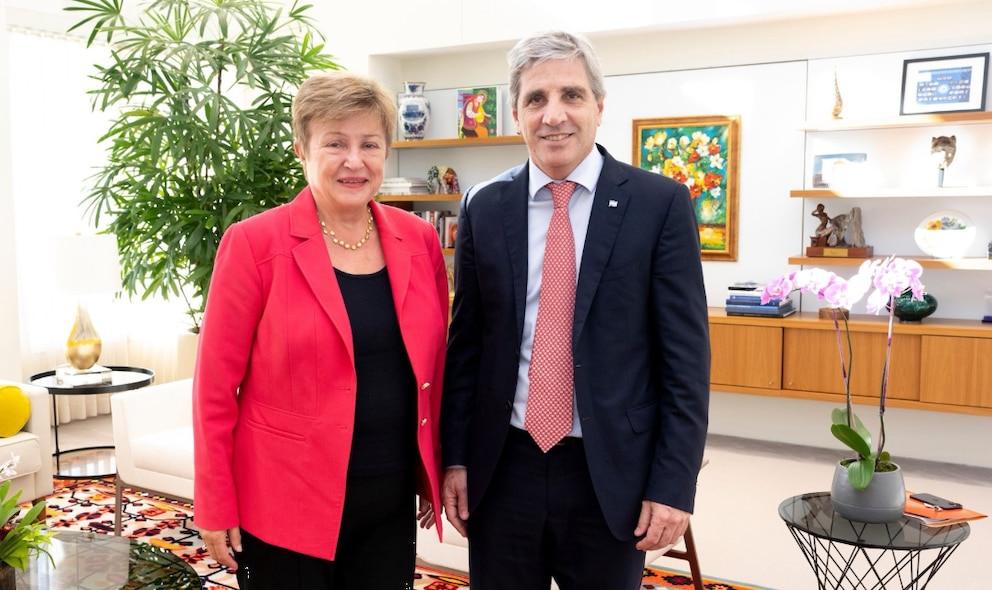
After a series of meetings with the economic team headed by Luis Caputo, the International Monetary Fund (IMF) announced that the visit of the technicians within the framework of the second review of the agreement signed with Argentina for USD 20,000 million in April 2025 had come to an end. Sources from the organization described the meetings as positive.
“The IMF technical mission headed by Luis Cubeddu and Bikas Joshi concluded its visit to Buenos Aires within the framework of the second review of the program and the Article IV consultation. Very good progress was recorded in the talks, which will continue in the coming days,” highlighted the entity chaired by Kristalina Georgieva.
The envoys of the lender of last resort held a series of meetings “with various interlocutors to learn their vision of the economic perspectives.”
Officials from the Treasury Palace evaluated as positive the meeting held last Tuesday with technicians from the International Monetary Fund, which lasted for much of the day.Shortly before 6 p.m., the IMF mission, led by Cubeddu and Joshi, left the Ministry of Economy without issuing statements.
The arrival of the international organization’s envoys represented a challenge for the Argentine Government, which sought the approval of a new “waiver” and the renegotiation of the reserves goal, necessary conditions to access a disbursement of USD 1,000 million, a figure that the market considers practically assured, although, for the moment, there was no news in this regard.
The IMF delegation arrived in Buenos Aires on February 5 to advance the second review of the agreement within the framework of the Expanded Fund Facility and discuss the Article IV consultation corresponding to the Argentine situation.
Regarding the reserves goal, the Argentine Central Bank assumed the commitment to close the fourth quarter of 2025 with positive net reserves of 2.4 billion dollars.After the first review, that objective was modified to a negative balance of 2.6 billion dollars.The economic team could not achieve this goal, in part due to an exchange policy aimed at containing the value of the currency and the sales made amid the volatility prior to the legislative elections of the previous year.
After canceling payments of 4.2 billion dollars to creditors at the beginning of the year, Minister Luis Caputo had to face the maturity of more than 800 million dollars with the International Monetary Fund in the first days of February.The official explained that the Government acquired Special Drawing Rights (SDRs) from the United States and used those assets to comply with the obligations.
Through his social networks, Caputo detailed the procedure adopted by the Government for the payment of interest to the IMF: “If they were paid in dollars, we would directly transfer the dollars to the Fund, but since they are paid in SDRs, it is necessary to buy them. We buy them from the United States, which is a seller of SDRs. It is a usual operation at market price,” he indicated.
Special Drawing Rights are an international instrument created by the International Monetary Fund, under the direction of Kristalina Georgieva.They serve as a store of value and unit of account between member countries.Their value is established based on a basket of major currencies and can be used to reinforce the international reserves of States.
News in development…

