


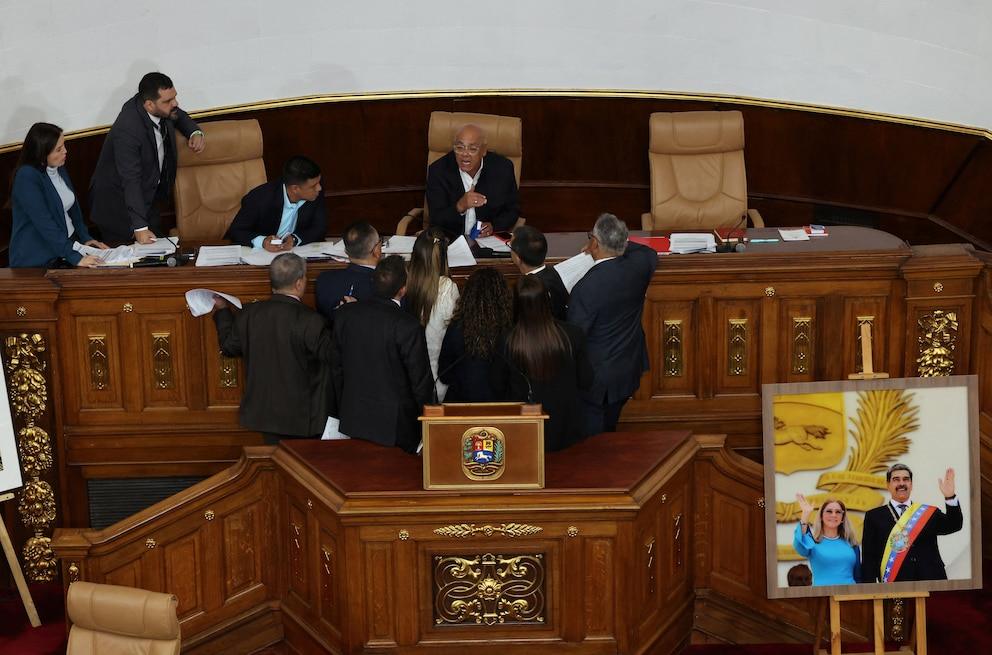
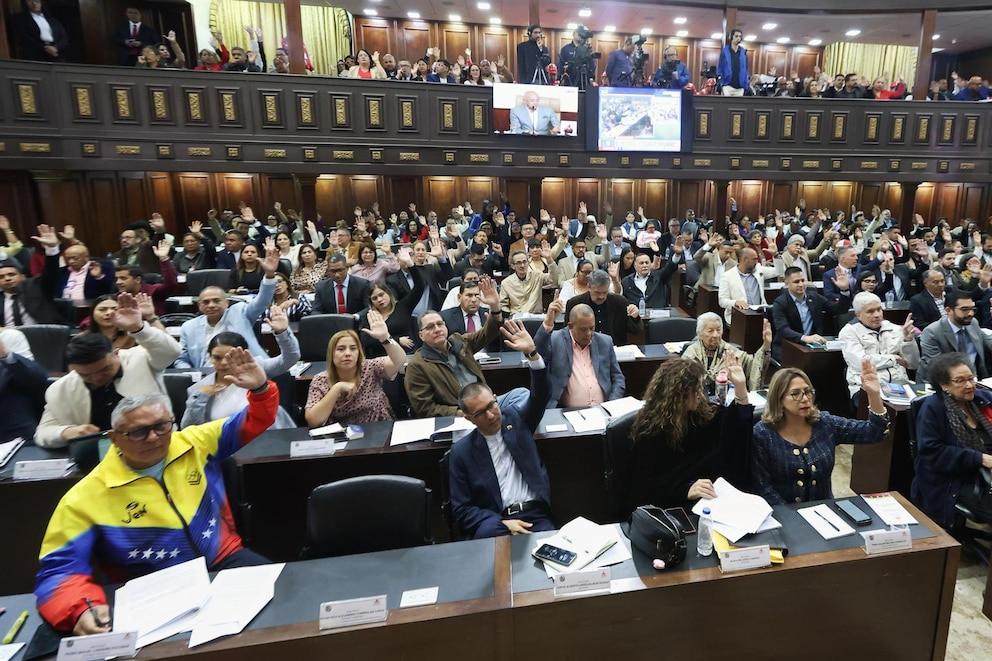
The Parliament of Venezuela, controlled by the Chavista regime, decided this Thursday to postpone the second and final discussion of the amnesty bill, after disagreements arose between the parliamentary blocs on a central article of the text, which prevented the final approval of the law from being finalized in the scheduled session.
The postponement was unanimously agreed upon after an extensive exchange between the deputies, when the plenary had advanced in the revision of the text up to article 6. The debate was suspended due to differences regarding article 7, which establishes the conditions that the beneficiaries must meet to access the amnesty.
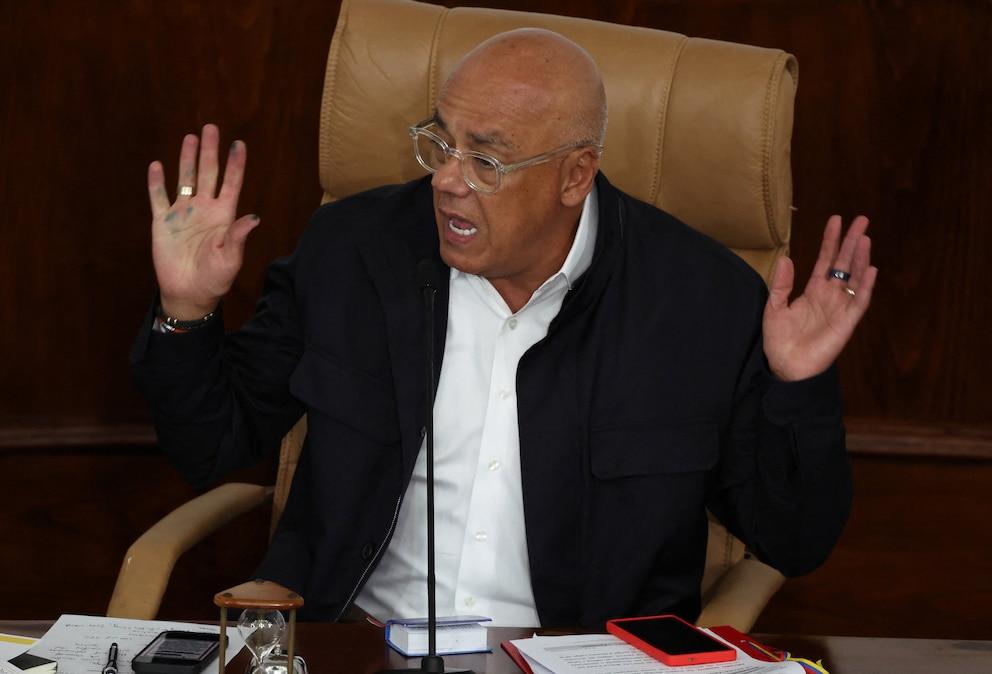
The head of the National Assembly, Chavista Jorge Rodríguez, confirmed the decision at the close of the session.
“We will continue the discussion in the next ordinary session, next week,” he stated from the chamber.
According to what was discussed in the room, the point of conflict was a provision that requires prosecuted or convicted people to appear before judicial authorities to avail themselves of the benefits of the law.This requirement generated objections among deputies who maintain that an amnesty must imply the immediate extinction of criminal cases, without additional conditions.
The bill has already passed its first discussion, but requires a second favorable vote to become law.This Thursday’s session had been called precisely to complete this process.
The National Assembly meets ordinarily on Tuesdays and Thursdays.However, due to the Carnival holiday, the next ordinary session was scheduled for Thursday, February 19, the date on which the debate on the pending articles will be resumed.
The text under discussion is framed in the political process opened after the capture of the drug dictator Nicolás Maduro and the protection of the United States over DelcyRodríguez for a transition.
Since then, Chavismo has promoted a package of measures aimed at abnormalizing the institutional situation and responding to internal and external pressures related to the situation of political prisoners.
Recent drafts of the project, known this week, introduce substantial changes with respect to previous versions.In particular, they fail to list in detail the crimes considered political in nature, such as instigation, resistance to authority, rebellion or treason, which were expressly mentioned in previous proposals.
The most recent versions also do not include provisions for raising Interpol red alerts, nor do they contemplate the restitution of assets seized from detained persons, the annulment of disqualifications from holding public office for political reasons or the reversal of administrative sanctions against media outlets, aspects that did appear in initial drafts.
According to the temporal scope presented by the Chavista regime, the amnesty would cover events that occurred from 1999 to the present.However, the most recent texts limit the benefit to specific episodes of political conflict, such as the attempted coup d’état in 2002 and the protests registered in certain periods of 2004, 2007, 2013, 2014, 2017, 2019 and 2024.

The attorney general imposed by Chavismo, Tarek William Saab, argued this week that the law could contribute to internal stability.“I hope this translates into a one hundred percent pacified country,” he declared.
The project establishes that those who have been convicted of human rights violations, war crimes, homicide, drug trafficking or crimes against public property will not be able to receive amnesty.In previous versions, cases of corruption were also excluded, a category that was no longer included in the most recent drafts, without the reasons being publicly explained.
While the legislative debate was suspended, outside the Central University of Venezuela in Caracas, hundreds of students and relatives of detained people gathered to demand the release of political prisoners and the approval of an unrestricted amnesty.
Human rights defense organizations have warned that the text, as proposed, does not guarantee a full amnesty.For the benefit to be effective, they maintain, it must imply the total elimination of charges, convictions, house arrests and other judicial measures associated with political causes.
(With information from EFE and Reuters)

