


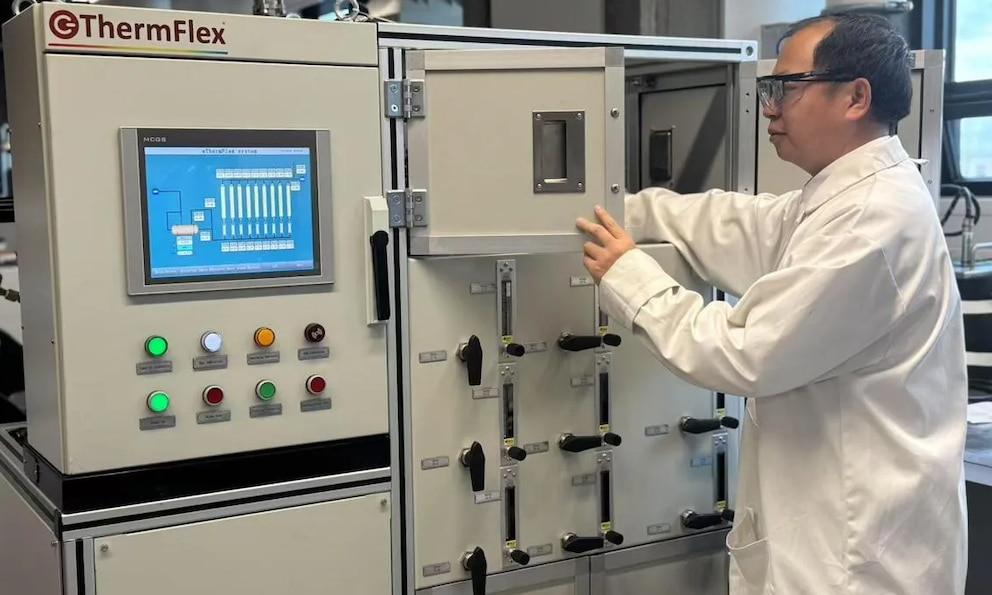
An innovative technology developed by the University of Birmingham promises to transform energy storage in commercial buildings.This system, based on advanced thermodynamic materials, seeks to improve efficiency and reduce energy costs, facilitating access to decarbonized services in urban environments.
The key to the system designed by the University of Birmingham is the use of high-density thermodynamic materials.These allow energy to be stored much more efficiently than traditional methods.
Unlike hot water tanks, which lose heat when the temperature equalizes that of the environment, the new system uses a controlled chemical reaction.In this way, the energy is kept intact until it is needed, avoiding losses during storage.
This technology acts like a fuel: it allows heat or cold to be stored for long periods and only releases it when the reaction is activated.Thus, it represents a practical alternative for buildings where heat pumps are not viable.

Among the main benefits identified by the University of Birmingham, the high energy density of these materials stands out.This allows for better use of space and greater storage capacity per unit of volume compared to conventional systems.
According to the university’s preliminary analysis, the solution may offer lower initial and operational costs.In addition, the system responds intelligently to signals from the electrical grid, allowing it to adjust to dynamic rates and demand peaks.
With this technology, buildings can charge energy when electricity is cheaper or more abundant.This guarantees flexible management, aligned with energy efficiency and sustainability objectives.

The University of Birmingham built a 5 kW demonstrator system at laboratory scale, validating the operation of the technology in real conditions.
The team, led by Professor Yongliang Li from the School of Chemical Engineering, is collaborating with a UK company to develop a fully integrated version and test it on a larger scale.
Currently, the university is looking for commercial partners to pilot the solution in sectors with high energy demand.These include heating, ventilation and air conditioning (HVAC) systems, manufacturing and commercial building management.These applications will allow the impact to be quantified and the technology to be adapted to different environments.

The adoption of storage systems with advanced thermodynamic materials could drive the decarbonization of commercial buildings.By capturing surplus renewable energy and using it efficiently at key moments, the flexibility and resilience of the electrical grid is increased.
This efficient storage, without significant losses, facilitates the use of clean energy even when generation exceeds immediate demand.
Thus, it helps reduce emissions from the building sector and supports the transition towards more responsible and sustainable cities, according to the University of Birmingham.

The University of Birmingham, through Enterprise, acts as a catalyst for scientific innovation, providing technical and strategic support to research such as this.Its services include mentoring, academic consulting and support for the creation of emerging companies specialized in energy solutions.
In this way, the university extends the reach of its technological advances, linking research with real opportunities for commercial application in the energy sector.
Currently, the key challenge for cities is to have flexible energy storage that allows them to make the most of clean energy.
The ability to store and release energy when commercial buildings require it is emerging as a decisive factor for the future of urban sustainability.

