



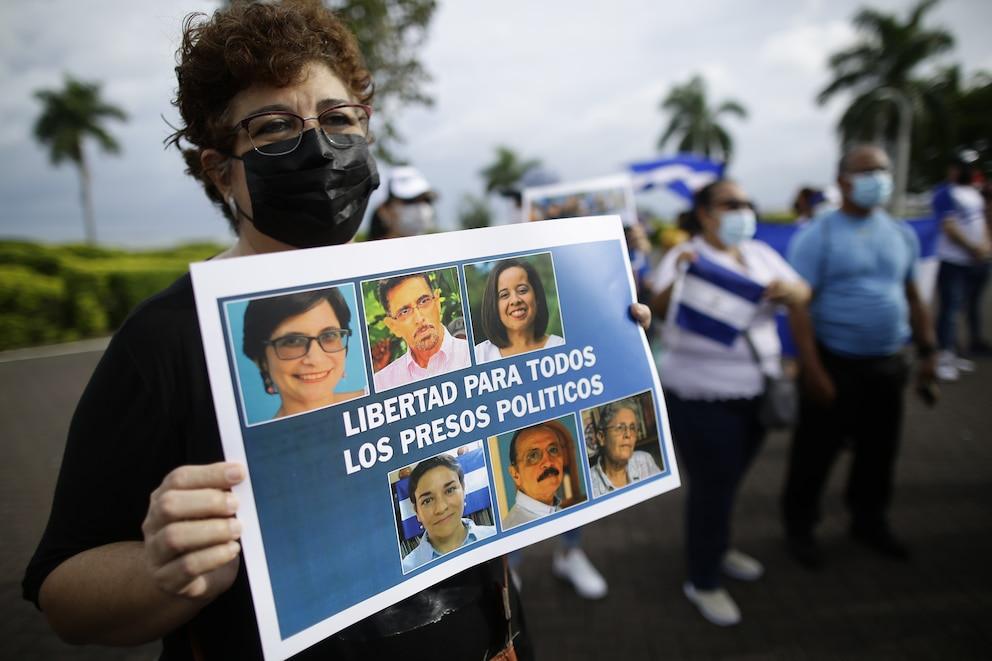
The Inter-American Commission on Human Rights (IACHR) this Tuesday demanded that the dictatorship of Daniel Ortega and Rosario Murillo put an end to human rights violations and release without conditions all people imprisoned for political reasons in Nicaragua.
The organization also called on the international community to adopt concrete measures to stop the repression and contribute to the restoration of democracy and the rule of law.
In its statement, the IACHR condemned “the persistent repression in Nicaragua, characterized by the continuation of arbitrary arrests and the deprivation of liberty for political reasons against any position perceived as opposition to the regime” led by Daniel Ortega and Rosario Murillo, whom it identified as responsible for a system of persecution directed against critical voices, social leaders and people linked even to sectors close to power itself.
“The human rights situation in Nicaragua constitutes one of the most serious cases observed in the region,” stated the Commission, which recalled that it is a main and autonomous body of the inter-American system.
According to the organization, in the country “an authoritarian regime has been consolidated based on control, surveillance and repression against any person perceived as an opponent, even linked to the regime itself, and that goes beyond the country’s borders.”
The IACHR warned that the repressive pattern is not limited to the national territory and that the actions of harassment and persecution extend to Nicaraguans who are outside the country.In this context, it reported that in recent weeks, through its Special Monitoring Mechanism for Nicaragua, it received information about the arrest of more than 60 people for expressing opinions on social networks related to recent events in Venezuela.
The agency noted that these new arrests contrast with the announcement made by the regime on January 10, 2026, when the so-called legal benefit of family coexistence was granted to 24 people detained for political reasons.For the Commission, this measure does not represent a real restitution of rights, but rather a form of control that keeps people released from prison under restrictive conditions.
In this sense, the IACHR warned that the indefinite legal situation, the obligation to periodically report to police stations and the imposition of permanent surveillance, as well as the restrictions on participating in meetings, religious events or expressing themselves on social networks, “leads to the freedom of the released persons being conditioned.”The organization stressed that these practices configure a control scheme that prolongs repression outside of detention centers.
According to information collected by Nicaraguan civil society organizations, at least 62 people remain deprived of liberty for political reasons, and some of them are in a situation of forced disappearance.
The Commission indicated that it maintains permanent monitoring of these cases and reiterated its concern about the lack of official information on the whereabouts, health status and detention conditions of several of the arrested people.
The IACHR recalled that Nicaragua has been going through a deep political and social crisis since April 2018, when massive protests broke out that were repressed by state forces and parapolice groups.This crisis worsened after the November 2021 elections, widely questioned by the international community, in which Daniel Ortega was re-elected for a fifth term, his fourth consecutively.

In those elections, the main presidential candidates and opposition leaders were in prison, and were subsequently expelled from the country, stripped of their nationality and deprived of their political rights, after being accused by the regime of “coup plotters” and of committing “treason to the country.”
Faced with this scenario, the Commission reiterated its call to States and international organizations to demand an end to repression, the full and unconditional release of all people detained for political reasons and the adoption of diplomatic and legal actions aimed at restoring democratic guarantees.
For the IACHR, the permanence of this pattern of persecution confirms that in Nicaragua there are no minimum conditions for the exercise of civil and political rights, nor for the free participation of citizens in the public life of the country.
(With information from EFE)

