



The government of Javier Milei faces a central conflict with the General Confederation of Labor (CGT) and Peronism over its project to modify the Argentine labor regime, highlighted the Financial Times.
The British newspaper described the debate as one of the most intense political disputes since the beginning of the administration, with the unions and Peronism as the core of the resistance.
The reform promoted by Milei seeks to make the labor market more flexible and reduce union interference in the negotiation of salaries and working conditions, in a context where almost half of the workers are informal and the level of registered employment has remained stagnant since 2011.
In this regard, the media cites that in October 2025 Milei himself said in a speech: “For too long the legal uncertainty about contracts, excessive costs and the fear of SMEs with each new hire pushed hundreds of thousands of workers into informality,” Milei said last October, in statements cited by the British media.
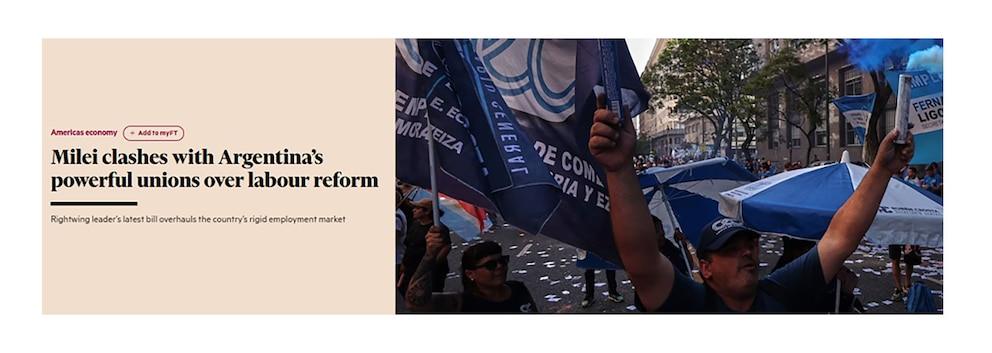
The CGT and Peronism, on the other hand, consider the protection of labor rights a historical pillar, they flatly reject the initiative and warn about the loss of individual and collective guarantees.”This reform was written by legal firms for large corporations that compiled requests from their clients, producing a Frankenstein project. It weakens several individual and collective rights and offers nothing to workers in return,” said Jorge Solá, one of the deputy secretaries of the CGT, quoted by the FT.
The note lists that the official project proposes, among other points, reducing the right to strike, extending the trial period for new employees, limiting judicial discretion in calculating compensation, extending the workday to 12 hours and prioritizing salary negotiations at the company level over national agreements.These measures, he says, raised the alarm in the unions, which are already preparing legal actions and evaluating whether to call strikes to reject them.
The union resistance occurs in a scenario in which, according to surveys cited by the British media, six out of ten Argentines support the need to change labor legislation, but .However, support decreases when specific aspects such as extending the working day or cutting compensation are consulted.Rodolfo Aguiar, general secretary of ATE, described the proposal as “a setback of a century” in terms of labor rights and proposes a general strike for February 11, something that the CGT has ruled out for now, limiting itself to a mobilization.
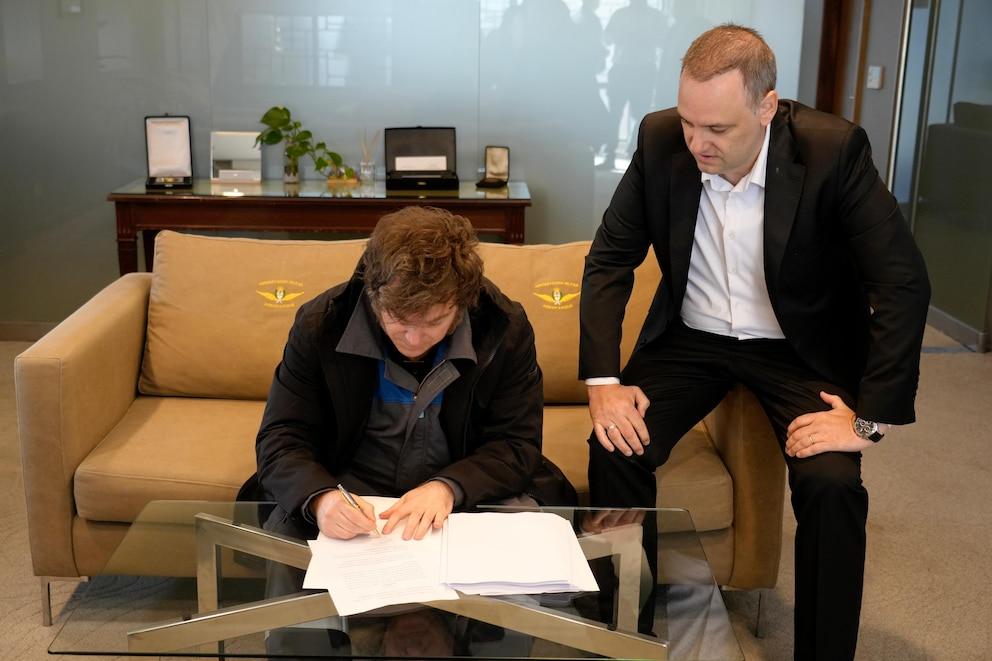
The Financial Times emphasizes that since the 1940s, unions have maintained enormous influence on the economic and social life of the country and that according to Peronism, current laws are essential to protect employees in a volatile economy and to prevent the worsening of inequality, while the government argues that the current system generated high levels of black employment and paralyzed the creation of registered employment.
The reform proposed by Milei, he claims, constitutes the biggest attempt in decades to limit the power of unions, which still manage everything from salary negotiation to health insurance and the administration of vacation centers, but whose strength has been weakened by the erosion of Peronism, the economic crisis and corruption scandals.Even so, he clarifies, the unions retain a significant capacity for pressure and seek to stop the advance of the official project.
One of the most sensitive points for the CGT and the unions is that the reform project provides non-members with the option of stopping paying the solidarity fee and ends the “ultra-active” or permanent nature of many agreements signed in 1975, in addition to prioritizing agreements by company or by region.In this regard, he quotes Armando Caro Figueroa, who was Minister of Labor during the government of Carlos Menem, who says: “the reform aims to decentralize the unions, which could be positive if done correctly,” but he warns that it is very “ideological” and that many of its articles could be rejected in labor courts, which are very biased towards unions.
The note highlights that while Milei seeks to negotiate with moderate legislators, the direct confrontation with the CGT has been reduced in recent months, but the pressure persists and the president could be forced to mitigate some aspects of the project to obtain the necessary votes.

The British newspaper also points out the ambivalence of the business chambers, saying that although the majority of companies support the flexibility and reduction of compensation, there is some reluctance to negotiate at the company level.”Currently, both parties are supported by abundant research. Imagine an average businessman debating salaries with each employee individually. The government prioritizes the individual, we prefer to protect the collective,” he quotes Ricardo Diab, president of the Argentine Chamber of Medium Enterprises (CAME).
The%20government%20argues%20that%20the%20reform%20allow%C3%A1%20increase%20%20formal%20employment%20and expand%20the%20tax%20base,%20key%20objective%20for%20the%20viability%20of the%20plan%20deapertura%20econ%C3%B3mica%20de%20Milei.%20Pablo%20Yeramian,%20due%C3%B1o%20de%20la%20textile%20Norfabril, cited%20in%20the%20note,%20says%20that%20the%20modifications%20in%20the%20compensationcions%20encourage%20take%20m%C3%A1s%20employees.%20But%20the%20daily%20brit%C3%A1unique%20getna%20also%C3%A9n%20that%20%20companies%20admit%20that%20employment%20dif%C3%ADeasily%20grow%C3%A1%20yes%20no%20reduce%20the%20tax%20burden%20and%20employer%20contributions,%20that%20they represent%20almost%20the%2070%%20of%20salary,%20sec%C3%BAn%20data%20of%20consultant%20Invecq.
Previous non-Peronist governments were unable to make structural changes due to the tenacious union resistance and the outcome of this fight will be a key political test for the Milei management.The result of the current political struggle, concludes the FT, remains open, in the midst of a scenario dominated by the struggle between the Executive, Peronism and the unions.

