



%20urban%20mobility%20is%C3%A1%20at%20a%20decisive%20moment%20at%20world%20level.%20Sec%C3%BAn%20arecent%20study%20of%20Boston%20Consulting%20Group%20(BCG),%20m%C3%A1s%20of%2090%%20of%20the%20citiesof%20world%20ya%20have%20established%20goals%20for%202035%20oriented%20to%20reduce%20%20use%20ofauto%C3%B3privateand%20prioritize%20a%20sustainable%20alternativessuchas%20transport%20p%C3%BAblic,%20the%20bicycle%20and%20travel%20on%20foot.
However, the report reveals that most cities are lagging behind, with progress much slower than expected and a gap that is difficult to close with respect to their own objectives.
The BCG City Mobility Compass report, based on more than 20 indicators and surveys of urban leaders, highlights both achievements and obstacles in the main cities of Latin America.
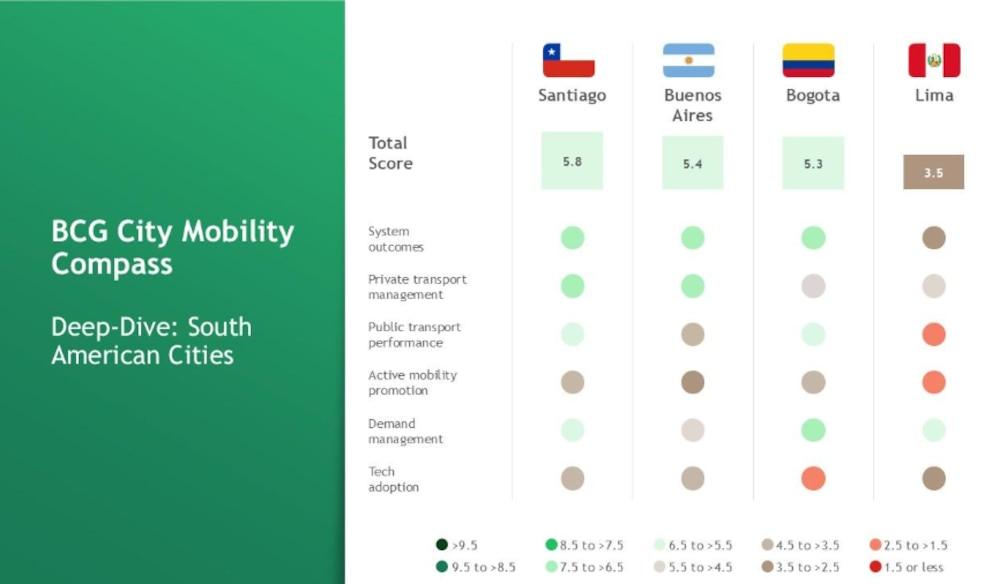
Santiago de Chile leads the region, with a score close to 6 out of 10 thanks to the solidity of its public transportation system and integration between metro, buses and active modes.However, it faces the challenge of increasing the frequency of transportation and improving the last mile.
Buenos Aires and Bogotá obtain similar scores, around 5.5 out of 10. Buenos Aires stands out for the variety and extension of its public transportation network, but faces challenges associated with the age of the subway, the quality of the service, and a lower boost in sustainability compared to Santiago.
In Bogotá, the BRT system boosts its performance, although congestion and overcrowding problems persist.The absence of an operational metro – under construction and planned for 2028 – is a key factor to improve.

For its part, Lima shows a greater lag, with a score of 3.5 out of 10. High levels of congestion, limited coverage of public transportation and strong dependence on informal transportation and private vehicles are the main weak points highlighted by the report.
The BCG analysis shows that cities with greater dependence on automobiles have CO₂ emissions per trip that are double those of robust public transportation systems, in addition to higher travel times.
In%20economy%C3%ADas%20in%20development,%20the%20lack%20of%20investment%C3%B3n%20will%C3%ADa%20do%20may%20%20access%20totransport%20p%C3%BAblic%20fall%20until%2015%20points%20percentage%20to%202040,%20while%20that%20capacity%20of%20the%20systems%20of%20rails%20per%20c%C3%A1pita%20may%C3%ADa%20decrease%20by%20a%2025%%20to30%%20due%20to%20population%20growth.

In the words of Cristián Carafí, managing director and partner of BCG, the gaps between the goals and real progress are significant: “Today the main cities in the region face gaps of between 10 and 15 percentage points with respect to their mobility objectives for 2035, in a context in which historically they have only managed to advance between 3 and 5 points per decade.”
The report highlights that the difference is made by decisions based on evidence and the comprehensive approach to public policies.Cities with less car dependence achieve up to double the emissions efficiency and generate substantial savings in time lost due to congestion.
Prioritizing the integration of public transport, service quality and last mile solutions is essential to close existing gaps.
The study concludes that urban transformation will only be possible if the main opportunities and challenges are precisely identified, overcoming isolated approaches and using real-time data to guide investments.
In this sense, BCG has developed the digital City Mobility HealthCheck Tool, which allows cities to evaluate their performance and compare it with that of similar cities, offering a practical guide for decision-making and long-term planning.

