


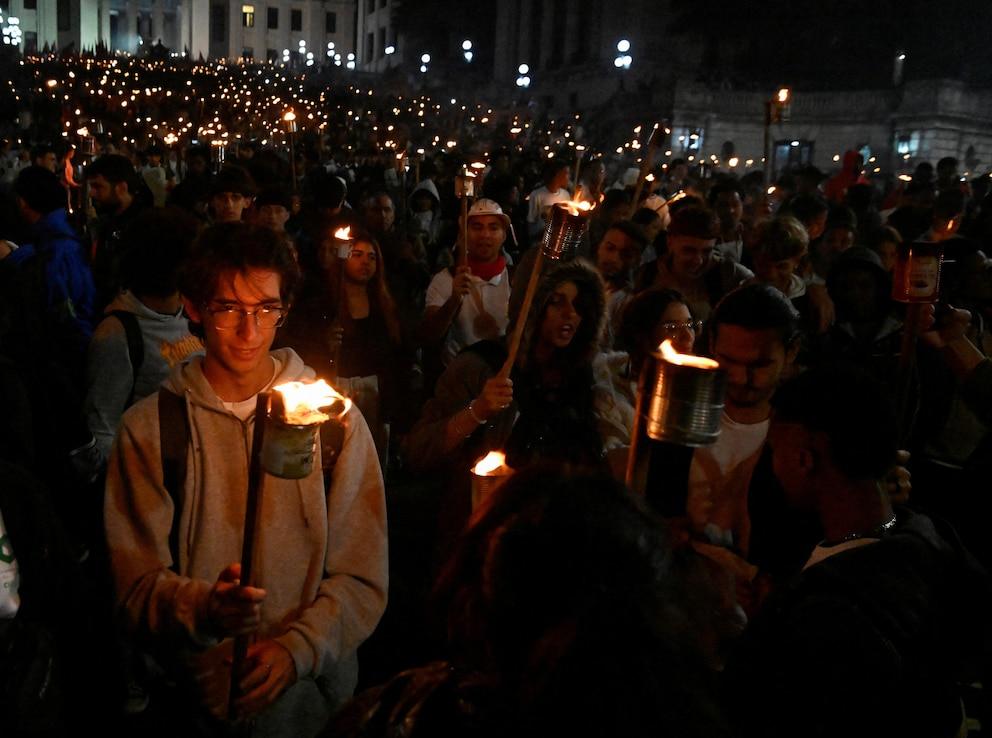
(From Washington, United States) The prestigious global organization HumanRights Watch (HRW) released an in-depth report that describes the illegal operations carried out by the Cuban regime to repress social protests motivated by the absence of political opening and the persistent economic crisis on the Caribbean island.
The dossier presented in Washington appears when there is a strong offensive by the Donald Trump administration to end the dictatorships of Venezuela, Cuba and Nicaragua.
The capture of Nicolás Maduro and the beginning of a new geopolitical stage between the White House and Havana complicated – even more – the economic situation in Cuba.
Without the cheap oil that Maduro provided and took advantage of the regime controlled by Miguel Díaz-Canel, the Cuban economy irremediably collapsed.
Added to the absence of fuel delivered by Venezuela is the loneliness that Cuba exhibits in the face of the explicit silence of China and Russia, which have always used the Caribbean island as a proxy against the United States.

“The government continues to repress and punish dissent and public criticism. Hundreds of critics and protesters, including many participants in the historic July 2021 demonstrations, continue to be arbitrarily detained,” says the report presented by HRW.
Regarding the social situation, Human Rights Watch stated that “the worsening economic crisis has undermined the population’s access to food, health care, and electricity.”
And he concluded: “Protests continue to break out over prolonged blackouts, shortages, deteriorating living conditions and the sharp increase in Internet costs.
The energy crisis is linked to the lack of fuel that affects the production of electricity.Cuba has been experiencing a severe shortage for three years that limits the operation of power plants.

Below is the summary of the report presented by HRW in Washington:
-“The authorities arbitrarily detain, harass and intimidate critics, independent activists, journalists and political opponents.”
-%E2%80%9CThe%20Cubans%20continue%20fleeing%20from%20pa%C3%ADs%20en%20grandes%20n%C3%BAmere.%20Sec%C3%BAn%20figures%20from the government,%20the%20pa%C3%ADs%20has%20lost%20aroundr%20del%2010%%20de%20su%20population%C3%B3n%20en%20los%20%C3%BAltimosa%C3%B1os.%20Studys%20independent%20indicate%20that%20the%20real%20figure%20could%C3%ADa%20be%20higher%22.
-“According to the non-governmental organization (NGO) Cubalex, at least 203 people were arbitrarily detained in police and state surveillance operations between January and June 2025.
-“The NGO Prisoners Defenders reported that, as of October, Cuba had nearly 700 political prisoners behind bars.”
-“The NGO Justicia 11J reported that 359 people related to the July 2021 protests were still in prison with sentences of up to 22 years”:
-“Critics of the government risk criminal prosecution and are not guaranteed due process, including the right to a fair and public trial before an independent and impartial tribunal.”
-“The courts continue to be subordinated to the executive branch. The families of political prisoners face harassment from the State. In several cases, State security agents visited their homes to harass them and dissuade them from reporting abuses.
-“Authorities have repeatedly denied medical care to prisoners, subjected them to overcrowded and unsanitary conditions, and have failed to ensure adequate access to food and water.”
“Families face restrictions on visits. Detainees do not have an effective reporting mechanism to seek redress for abuses.”
-“The government denies access to prisons to Cuban and international human rights groups.”
-“The government controls all media, restricts access to outside information and censors critics and independent journalists.”
“In May, Cuba’s state telecommunications monopoly, ETECSA, significantly increased Internet prices, making it difficult for most Cubans to access it.”
-“According to Justicia 11J, ETECSA’s price increases caused 46 protests in June, the highest number caused by a specific event in 2025.”

