


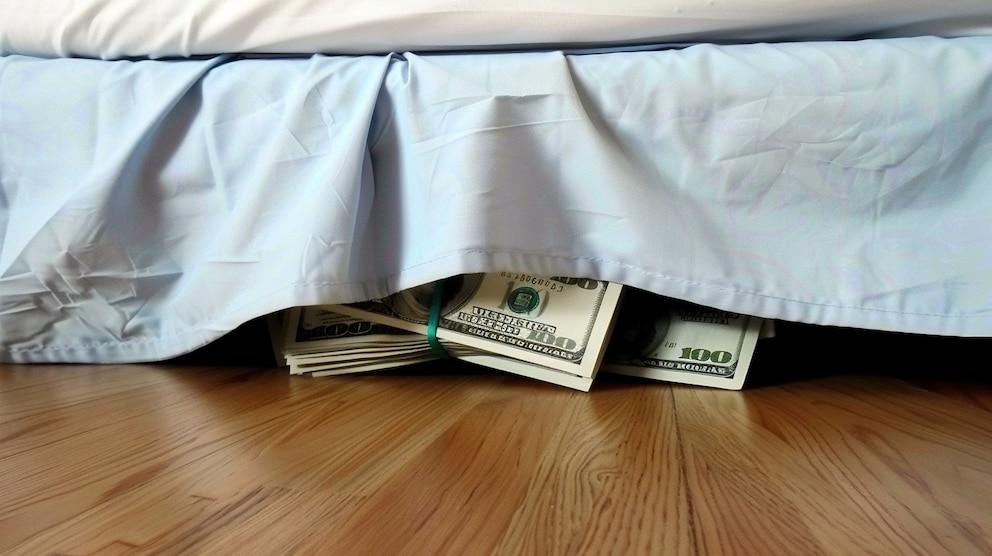
More than a month after the Senate turned the Fiscal Innocence project into law, and the fight between the Minister of Economy, Luis Caputo, and the private banks about how to put it into practice, the regulatory decree was published with details on how the dollars should be taken out of the mattress and what benefits the Simplified Earnings Regime (RSG) gives to taxpayers.
In the coming days there would be more complementary regulations and it is expected to see the reaction of private entities.
The regulation defined the fine print of the law with which Minister Caputo intends to give legal security to Argentines so that they can take the dollars out of the mattress, which is estimated to total USD 170 billion, which would help the reactivation of activity, key in the current phase of the economic program.
One of the most important definitions is how operations should be carried out with mattress dollars.“In order to use them, it is necessary to bank them and the decree gives you the option to bank them both at the origin and at the destination,” commented a source from the Customs Collection and Control Agency (ARCA) in off the record.In practical terms, the taxpayer will have two options: they can deposit them in the bank in their account and then make a transfer to another person or directly send the money to another person.
“You can use the dollars from the mattress to the extent that they are banked, because in this way you comply with the recommendations of the FATF and the International Monetary Fund (IMF) that it is best for the money to be banked because it is traced,” stressed the same source in dialogue with Infobae.This was defined so that the national treasury can track the money and monitor the financing of terrorism or money laundering.At the same time, money within the financial system allows financial circulation and increases credit.
It was Minister Caputo who stated last week that the Fiscal Innocence Law is a “huge shortcut” to a faster reactivation of the economy.
“The data from the Central Bank say that there are USD 170 billion under the mattress of Argentines and the private sector deposits are USD 67 billion, there are almost three times the level of deposits that there are in the private sector in the mattresses. Imagine if that were in the coming months to the financial system, I’m not even telling you everything, half of that, Argentina’s problems would be solved,” he said in conversation with Radio Miter.
Another clarification is about the Simplified Earnings Regime (RSG), which in order to join three requirements had to be met: having had income of less than $1,000 million in the last year, assets of less than $10,000 million and not being identified as a large taxpayer.
“The decree comes to clarify that the income is added – to give you an example, taxed, untaxed and exempt – only your own. That is, you do not have to count what you receive, for example, when you are an intermediary,” detailed the official source. The benefits are also defined for those taxpayers who adhere to the RSG, which are a presumption of accuracy and liberating effect of the payment.It clarifies what is meant by significant discrepancy, under what conditions, and provides operational certainty that was lacking in the law.
The monotributistas, explained in ARCA, in order to withdraw the dollars from the mattress they must register with the RSG;Otherwise, they will be exposed to inspection.Small taxpayers will have to evaluate what is best for them: take the dollars out of the mattress and pay more taxes or not do so and run the risk of being investigated.
Within the organization led by Andrés Vázquez, they trust that monotributistas who want to get the dollars out of the mattress will join the RSG. As Infobae learned from unofficial sources, ARCA General Resolutions in that regard will be published in the coming days.

It remains to be seen whether the official regulations are sufficiently satisfactory for private entities to receive the dollars from the cushion or whether they demand more specifications from the Financial Information Unit (UIF), which is in the midst of a change of authorities.
Regarding the change in punishment thresholds, which for simple evasion go from $1.5 million to $100 million, the decree explains what happens.“The causes, the complaints that have been there since before the publication of the Decree, the taxpayer accused can request the application of the most benign criminal law,” they highlighted behind the doors of the national treasury.It is a possibility that they can resort to since the publication of the law in the Official Gazette.”From now on, we must consider the punishable threshold on the dates of the crime’s commission. Because the same law provides that this threshold, which was determined at $100 million, be updated annually by a method,” stated the agency’s technical source.
Another%20of%20the%20issues%20that%20generated%C3%B3%20commotion%20during%20the%20treatment%20of%20the%20Innocence%20Law%20Prosecutor%20was%20the%20update%C3%B3n%20of%20a%20100,000%%20of%20the%20automatic%20%C3%A1tic fines, with%20the%20consequences%20that%20will have%C3%ADa,%20on%20all%20for%20the%20small%C3%B1as%20and%20medium enterprises%20 (SMEs).
“There is an instruction not to automate the issuance of the notice for taxpayers who are not the most relevant,” stated the official source consulted.
Thus, the national treasury will discriminate by taxpayer and SMEs in general to give them an additional waiting period so that they can regularize spontaneously.Instead of automatic notifications, reminders will be sent for the taxpayer to regularize their situation before the investigation begins for the application of the fine.

