


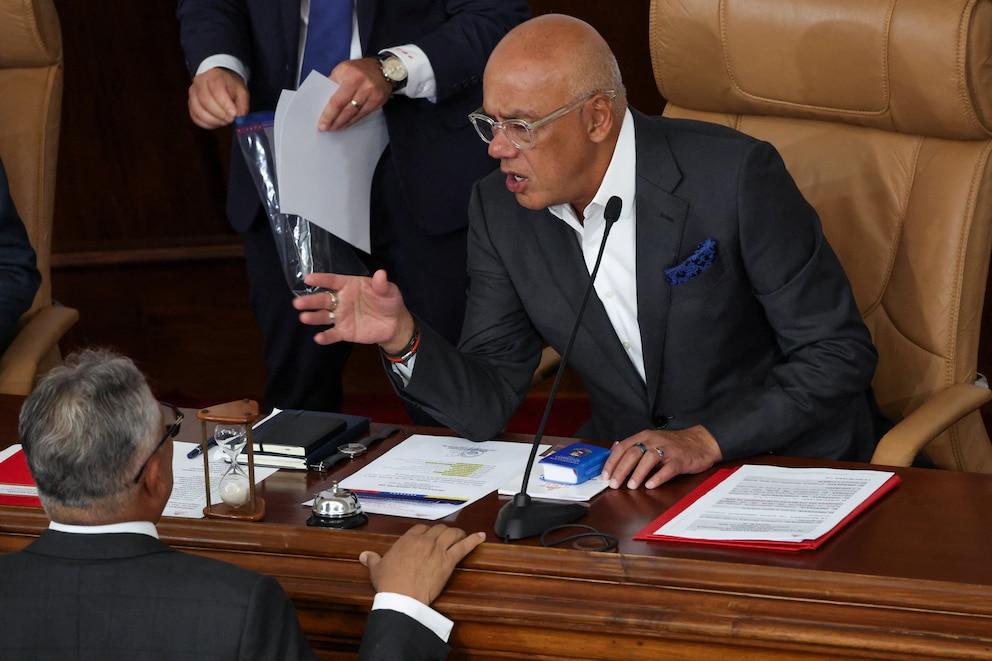
The president of the Venezuelan National Assembly, Jorge Rodríguez, requested this Friday that the voices of the relatives of political prisoners be heard during the public consultations on the amnesty bill approved in the first discussion.In addition, Rodríguez met on Friday with relatives of political prisoners at a detention site in Caracas and promised their release within a week at the latest.
“By Friday at the latest, they will all be released,” promised deputy Jorge Rodríguez in front of the headquarters of the National Police cells known as zone 7.
Rodríguez urged parliamentarians to take to the streets and talk with the victims and their loved ones to collect proposals that can be incorporated into the second parliamentary discussion.
During an intervention broadcast by Venezolana de Televisión (VTV), Rodríguez, who also leads the negotiation on behalf of the Executive, reiterated the need to “ask for forgiveness and rectify,” while underlining the importance of “forgiving.”He explained that the bill, promoted a week ago by his sister and acting president, Delcy Rodríguez, does not exclusively contemplate releases, but also mechanisms for reparation for victims of anti-government protests.He requested that this aspect be expressly contemplated in the final regulations.
The president of Parliament participated in a national meeting in Caracas organized by the Secretariat of Parliamentary Affairs of the United Socialist Party of Venezuela (PSUV).There, he also proposed the development of laws aimed at “caring for peace and life,” in the face of what he called “interesting times” for the country.

The Venezuelan Parliament, under Chavista control, advanced this week in the process to approve an amnesty law aimed at political prisoners of the last 27 years, excluding serious crimes such as human rights violations, crimes against humanity and war crimes.The proposal, presented on January 30 by the president in charge, Delcy Rodríguez, coincides with a release process that began on January 8, after the capture of Nicolás Maduro and Cilia Flores by US forces in Venezuela.
The bill, called “amnesty for democratic coexistence,” includes 13 articles and establishes general provisions to define its object, principles and application criteria.According to a statement of reasons shared with the EFE agency by a deputy under anonymity, the rule seeks to regulate the process under standards of equality, leaving out of its benefits those who are accused or convicted of especially serious crimes such as intentional homicide, corruption and drug trafficking.

In the parliamentary session this Thursday, Jorge Arreaza, deputy and former chancellor, was in charge of delivering the text to the Legislature.Arreaza stressed the need to “heal wounds” and “jointly build the steps and paths” towards national reconciliation.For his part, Rodríguez recalled the story of his father, murdered by a police force in the 1970s, to vindicate the right of victims to be heard and the duty of society to avoid new reprisals.He also alluded to the US attack that occurred on January 3, in which 120 people died and Maduro and Flores, both currently detained in New York, were arrested.
Deputy Nicolás Maduro Guerra, son of the former dictator, supported the call for unity and to avoid “violence, hatred, missiles, military invasion and kidnappings of presidents.”He mentioned the phrase of opposition deputy Luis Augusto Romero: “Venezuela cannot tolerate one more revenge.”
During the debate, opposition parliamentarians proposed that the law include reincorporation guarantees for those released, allowing their return to public life without fear of reprisals.Deputy Tomás Guanipa, whose brothers remain detained, stressed that the regulations must respond to “international standards” and guarantee equal treatment.David Uzcátegui, for his part, defended that the law ensures reunion, full freedom and spaces for victims to be heard and dignified.
According to data from the NGO Foro Penal, since the beginning of the release process, 383 political prisoners have been released until February 2, although the Minister of the Interior and Justice, Diosdado Cabello, places the figure at 895 released since November, denying the existence of political prisoners in Venezuela.
Venezuelan legislation provides that the law will go through a second discussion after the public consultation phase, at which time the articles will be evaluated individually and the final version of the regulations will be decided.
(With information from EFE)

