


Fernando Rospigliosi reported that a motion of censure was formally presented against President José Jerí, after the parliamentarians who promoted the measure corrected initial observations on the document.The announcement was made through its official account on the social network X, where it detailed the status of the parliamentary procedure.
In his message, the legislator noted that the promoters “made several errors” in the first version, but that these “have been corrected and they have just presented the motion in SEVEN different parts (it is not normal, but it has been accepted).”With this, he stated, the process was enabled for evaluation in the plenary session.
Rospigliosi specified that the motion was submitted with 78 signatures, a figure that constitutes the minimum required for it to be admitted and debated. As he explained, reaching that number made it possible to activate the corresponding parliamentary procedure and coordinate actions with the Board of Directors.
The legislator also indicated that, after meeting this requirement, “it was decided that an extraordinary plenary session would be called to discuss the censure of President José Jerí.”The call was made official shortly after through a formal summons addressed to the congressmen.

The Congress of the Republic issued the summons titled “Extraordinary Session of the Plenary Session of Congress”, which establishes that the meeting will be held in person on Tuesday, February 17, 2026 at 10:00 a.m.m.The document specifies that the call is made “by order of the President in charge of the Congress of the Republic and in accordance with article 50 of the Congress Regulations.”
The session will take place in the José Faustino Sánchez Carrión Building, where legislators will debate the motion of censure presented against the head of state.With this call, the process enters its decisive phase, in which the plenary session must evaluate the arguments and vote on whether to approve or reject the measure.
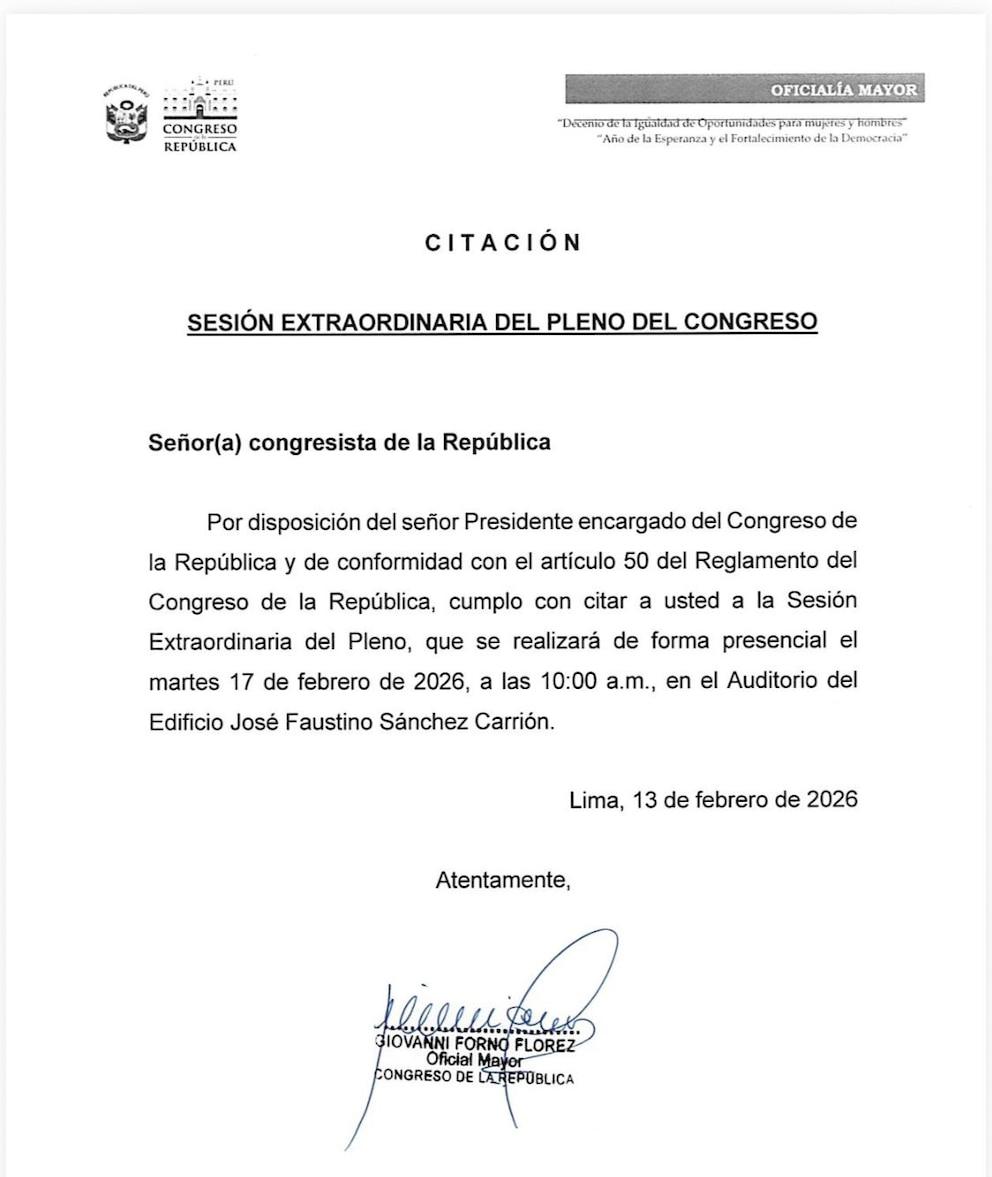
The Congress of the Republic will debate a total of seven motions of censure presented against the head of Parliament, who currently exercises the Presidency of the Republic by constitutional succession.According to the official agenda of the extraordinary session of February 17, 2026, the requests were entered between January 21 and 27 by legislators from various groups and ungrouped congressmen.
The parliamentary initiatives correspond to the motions numbered 21240, 21241, 21247, 21251, 21256, 21257 and 21284, all aimed at the plenary evaluating the permanence of the legislator in the presidency of the Legislature.In several of the documents, it is expressly requested that Congress “censure the president of the Congress of the Republic” or the congressman in that capacity, which would imply his departure from office if the vote is successful.
The foundations set out in the texts include questions about their ethical, political and institutional suitability to continue exercising functions, as well as arguments linked to the leadership of Parliament in the current political context.One of the motions states that it would not have “the political and institutional suitability necessary for the leadership of Parliament in the current context of democratic transition.”
Likewise, some requests propose that, if the censure is approved, the position be declared vacant and that the presidency be assumed immediately by the corresponding vice president, in accordance with the Regulations of Congress and the applicable constitutional provisions.

