


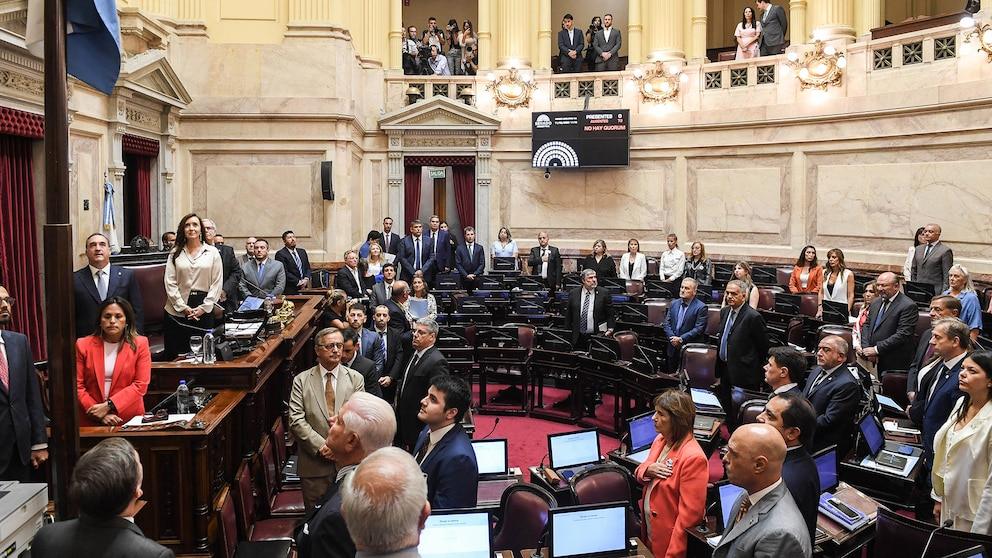
Prior to its treatment in the Senate, 28 modifications were introduced to the labor reform project, which was finally approved in the early hours of this Thursday.Vacations, compensation for dismissals and bank hours are some of the points in the text that will have a more immediate impact on workers.
These were not modified during the negotiations in recent weeks between the Government, companies and unions, but in the final text you can see in detail what the legislators voted for.
Firstly, according to the rule, annual leave must be granted between October 1 and April 30 of the following year.Workers and employers may, by mutual agreement, arrange to take vacations outside the established period.
The start date of the vacation must be notified in writing to the employee no less than 30 days in advance.Collective Work Agreements may establish different notification systems, according to the particularities of each activity.

As a novelty, the employer and the worker can agree to split the vacation period.Each of the sections must not be less than seven consecutive days.
When vacations are not granted simultaneously to all the workers of an establishment, workplace, section or sector, and are agreed upon individually or by groups, the employer must organize them so that each worker enjoys his or her vacation, at least once every three years, during the summer season.
The project maintains that, in the event of dismissal without just cause, the employer must pay compensation equivalent to one month’s salary for each year of service or fraction greater than three months.The calculation basis must be the best, normal and usual monthly remuneration received during the last year or during the time of provision of services if this is less.
However, unlike the current scheme, non-monthly payment concepts, such as the Annual Complementary Salary or bonuses that are not paid monthly, are not included in the calculation base.
The%20amount%20of%20compensation%C3%B3n%20cannot%20exceed%20three%20times%20the%20average%20monthly%20expected%20in%20the%20agreement%20collective%20applicable,%20excluded%20the%20old%C3%BCage.For%20who%20not%20est%C3%A9n%20under%20agreement%20collective,%20it%20applies%20the%20cap%20of%20agreement%C3%A1s%20favorable%20of%20establishment.%20The%20compensation%C3%B3n%20cannot%20be%20lower%20than%2067%of%20the%20remuneration%C3%B3n%20monthly%20normal%20and%20usual,%20and%20never%20lower%20a%20a%20month%20of%20salary.

The receipt of this compensation implies the definitive extinction of any judicial or extrajudicial claim linked to the dismissal, except actions based on criminal offenses.Likewise, the law provides that, through a collective agreement, the parties can replace this regime with a severance fund or system run by the employer.
In the event of the death of the worker, the beneficiaries (spouse, cohabitant, minor or disabled children, and failing that, other immediate family members) are entitled to compensation equal to that for dismissal.
The employer and those with joint liability are the only ones responsible for paying compensation.If the employer decides to use resources from a Labor Assistance Fund, it must comply with a notification and documentation procedure, and the transfer to the worker must be made within a maximum period of five business days.
On%20other%20part,%20the%20text%20establishes%20that,%20in%20case%20of%20judicial%20conviction%20for%20labor%20compensation,%20the%20employsdor%20can%20pay%20the%20amountin%20installments.%20For%20large%20companies,%20the%20m%C3%A1maximum%20allowed%20is%20of%20six%20monthly installments%20consecutives;%20for%20micro,%20small%C3%B1as%20and%20medium%20enterprises,%20up to%20twelve%20monthly%20consecutive installments.%20These%20quotas%20must%20be%20adjusted%20according to%20a%20variation%C3%B3n%20del%20%C3%8Dindex%20de%20Prices%20al%20Consumer%20(CPI)%20m%C3%A1s%20a%20rate%20de%20inter%C3%A9annual%20del%203%,
Cuando el contrato es a plazo fijo y el despido se realiza antes delvencimiento, la indemnización se calcula considerando la antigüedad que sehabría acumulado hasta el final del plazo original.For temporary contracts, the same general criteria apply.
According to the project that obtained half a sanction in the Senate, the overtime compensation regime may be formalized by agreement between the employer and the worker, as long as both parties sign it in writing.The regulations establish that the provision of overtime must be voluntary, have clear limits and a control system that allows recording the hours worked and those available for the worker’s enjoyment.

Compensation alternatives include the overtime regime, the hours bank and compensatory francs, according to the current working day framework.
In accordance with labor legislation, this type of agreement can also be concluded between the employer and the company’s union representation.In all cases, the regime must respect the minimum breaks required by law, with the aim of guaranteeing the protection and benefit of the worker.
Regarding reduced working hours, the rule states that it can only be implemented when provided for by current laws, individual contracts, Collective Labor Agreements or collective agreements signed with union representation.These instruments can establish methods for calculating the maximum working day based on averages, according to the characteristics of each activity, provided that the minimum breaks of twelve hours between days and thirty-five hours for weekly rest are respected.
The hour bank system makes it possible to compensate for a longer working day on certain days with a shorter working day on others, as long as the legal maximum for the week is not exceeded or that determined by the specific labor regime, either by special law or by collective agreement.

