


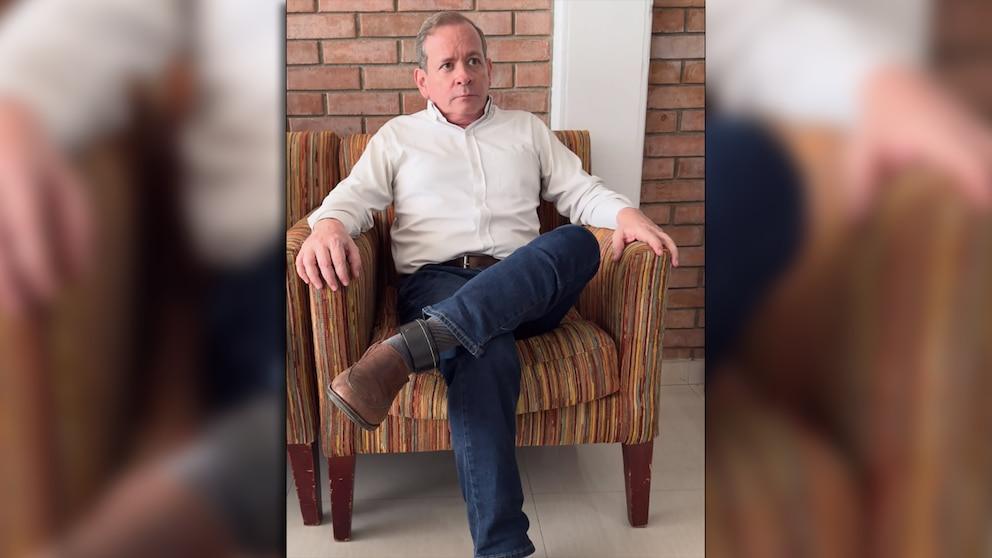
After more than 24 hours in a condition of forced disappearance, this Tuesday the first image of the Venezuelan opposition leader Juan Pablo Guanipa was released under house arrest in Maracaibo, under strict control measures imposed by the Chavista regime.
The photograph, released on social networks by Claudia Macero, spokesperson for MaríaCorina Machado, shows Guanipa sitting inside his home, with his legs crossed and an electronic shackle placed on his ankle.This is the first visual evidence of his situation after the period in which family members and friends reported that they did not know his whereabouts after his second arrest.
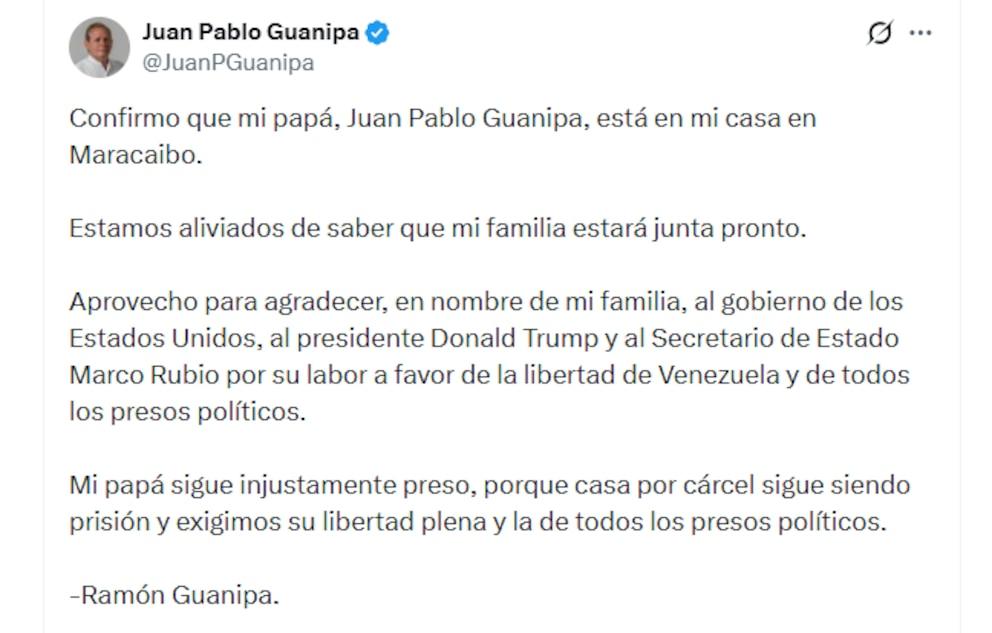
The confirmation that the leader was at home was made by his son, Ramón Guanipa.
“I confirm that my father, Juan Pablo Guanipa, is at my house in Maracaibo,” he wrote on the X social network, while expressing the family’s relief at his return home.However, he stressed that the measure does not amount to a release.
“My father is still unjustly imprisoned, because house to prison is still prison and we demand his full freedom and that of all political prisoners,” he stated.
According to what was reported by those around him, the house arrest measure includes the permanent use of an electronic surveillance device, a prohibition on making statements to the media, limitations on publishing on social networks and the presence of police officers stationed in the vicinity of the home.
According to his son, these are stricter conditions than those he previously had.
Ramón Guanipa also pointed out that the family did not receive prior notification about the leader’s transfer to the city of Maracaibo.He indicated that they found out about the measure when police officials showed up at the residence to carry out the procedure.The leader was taken to the building in custody, after remaining incommunicado for more than a day.
Juan Pablo Guanipa had been released from prison on Sunday, after being deprived of his freedom since May of last year.After his departure, he offered public statements in which he called for reconciliation in the country, although he stressed that it had to be found “with the truth” and maintained that Venezuela “has the right to be a free country.”
Hours later, during the night, he was intercepted by unidentified men while he was traveling in a vehicle and was detained again.Since that moment, his family reported that they had no official information about his place of detention, nor had they been able to establish contact with him.Faced with this situation, RamónGuanipa publicly demanded proof of life and his immediate release.
During that period, the leader’s son reported that he maintained contact with US Senator Rick Scott, who publicly questioned the new arrest.The family insisted that there was no legal justification for the measure, assuring that Guanipa had not breached any prior judicial conditions.
“There was an injustice, because he did not violate any precautionary measure and now he has even fewer freedoms,” Ramón Guanipa declared to the press in Maracaibo, after the house arrest was confirmed.As he explained, in addition to the electronic shackle, his father must comply with a control regime that limits his mobility and his public communication.
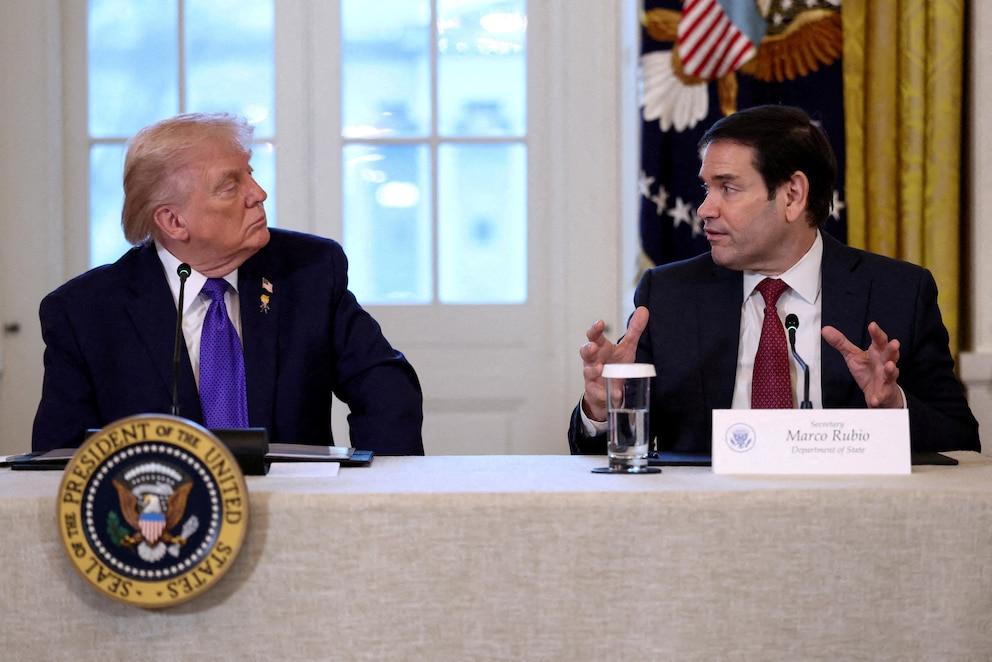
Ramón Guanipa himself also thanked the international support received in the last few hours.In a message spread on social networks, he expressed his gratitude to the United States Government, President Donald Trump and Secretary of State Marco Rubio “for their work in favor of the freedom of Venezuela and all political prisoners.”
The case of Juan Pablo Guanipa occurs in the middle of a release process announced since the beginning of January.
The non-governmental organization Foro Penal reported that it has verified at least 426 releases since the beginning of this process, while the authorities assure that the number of people released amounts to 897, without an official list having been published so far.
The situation also coincides with the development of a public consultation on a draft amnesty law approved in the first discussion by Parliament, which still must be subjected to a second debate for its eventual sanction.
(With information from EFE)

