


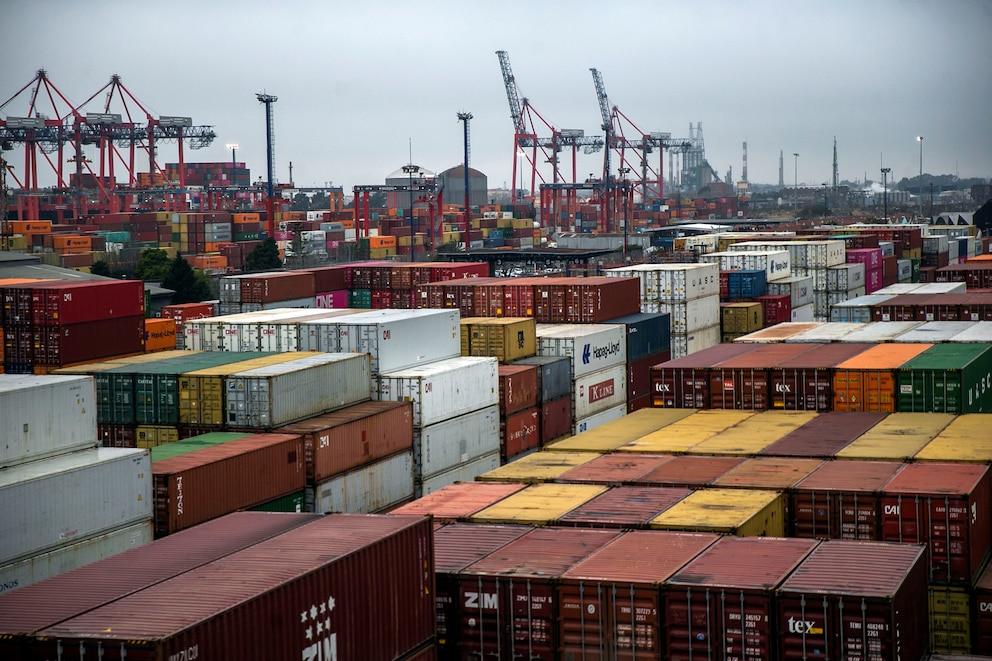
The Argentine economy was the fifth most closed economy in the world in 2024, according to an international ranking prepared based on the percentage that imports have in the Gross Domestic Product (GDP) of each country.
If this ranking is read from below (that is, from those states that matter the least in relation to the size of their GDP), Argentina appears fifth, behind Sudan, Venezuela, Turkmenistan and Ethiopia.The Top 10 is completed, among others, by Venezuela, the United States and China, economies that, for different reasons, show a low participation of foreign purchases in relation to their GDP.
In%20cases%20like%20the%20of%20China%20and%20USA%20weighs%20a lot%20the%20size%C3%B1or%20of%20the%20econom%C3%ADa,%20del%20samemode%20que%20las%20econom%C3%ADas%20m%C3%A1s%20%E2%80%9Cabiertas%E2%80%9D%20of%20world%20are%20in%20general%20small%C3%B1as%20andorganized%20of%20a%20way%20that%20doe%20that%20the%20volume%20econ%C3%B3mico%20of%20the%20imports exceed%20the%20100%%20of%20GDP.
The survey takes imports as a percentage of GDP as its central indicator, a variable commonly used to analyze the degree of openness or closure of an economy.According to the methodological criterion of the ranking, “the weight of imports in relation to GDP allows us to compare how much countries depend on goods and services produced abroad”, a definition that summarizes the approach of the work disseminated by Visual Capitalist, a medium specialized in visualizing economic and financial data, which prepared the report based on statistics from the International Monetary Fund (IMF) and the World Bank.
In%20that%20context,%20Argentina%20appears%20in%20el%20position%20n%C3%BAmero%20cinco%20entre%20las%20diezeconom%C3%ADas%20m%C3%A1s%20closed%20of%20planet,%20with%20imports%20equivalent%20to%2013%%20ofGDP.%20By%20above%20are%20located%20Sud%C3%A1n,%20with%20barely%201%;%20Venezuela,%20with%209%;%20Turkmenist%C3%A1n,with%2011%;%20and%20Etiop%C3%ADa,%20with%2012%.%20By%20below%20of%20Argentina%20figure%20UnitedStates%20(14%),%20Banglad%C3%A9s%20(16%),%20Pakist%C3%A1n%20(17%),%20China%20(17%)%20and%20Chad%20(18%).
The ranking highlights that the condition of “closed economy” does not respond to a single cause or the same productive profile.In some cases, these are countries with strong trade restrictions, internal conflicts or structural limitations.In others, such as the United States or China, the relative low weight of imports is linked to the size of their internal markets and the breadth of their productive structure, which reduces the need to source supplies abroad in proportion to GDP.
The inclusion of Argentina in this group responds to a combination of factors. The low level of imports in relation to the product reflects both macroeconomic restrictions and limitations on access to the exchange market, in addition to a productive structure with difficulties in integrating into international trade in a sustained manner.The indicator does not measure trade flows in absolute terms, but rather their relative weight within the economy, which explains why countries with large volumes of imports can appear as “closed” if their GDP is even higher.
The%20contrast%20se%20becomes%20m%C3%A1s%20evident%20al%20observe%20the%20other%20extreme%20of%20ranking.Between%20the%20ten%20economy%C3%ADas%20m%C3%A1s%20open%20of%20world,%20the%20weight%20of%20imports%20exceeds%20widely%20the%20100%%20of%20GDP%20in%20several%20cases.%20Hong%20Kong%20leads%20the%20listedwith%20imports%20equivalent%20to%20178%%20of%20GDP,%20followed%20by%20Luxembourg%20(160%),San%20Marino%20(155%)%20and%20Singapore%20(144%).
In these countries, the high share of imports is usually associated with their role as logistical, financial or commercial centers, small economies highly integrated into global trade, or productive models based on re-export.In several cases, imports exceed GDP because goods enter the country to then be processed or sent to other destinations.
The report highlights that “small economies tend to depend more on foreign trade, since they do not have large internal markets or a diversified productive base,” a characteristic that explains why the top positions in the ranking of most open economies are occupied by territories with a low population and a high degree of international integration.
The%20comparison%C3%B3n%20between%20both%20extremes%20allows%20to dimension%20the%20relative%20position%20ofArgentina%20in%20the%20global%20map%20of%20trade.%20While%20los%20pa%C3%ADses%20m%C3%A1s%20openshow%20a%20strong%20interdependence%20with%20the%20world%20market,%20the%20econom%C3%Adas%20m%C3%A1sclosed%20present%20a%20lower%20exchange%20of%20goods%20and%20services%20with%20the%20exterior%20in relation%C3%B3n%20with%20its%20level%20of%20activity.%20In%20the%20case%20Argentine,%20the%2013%%20of importis%20above%20the%20GDP%20the%20places%20very%20by%20below%20the%20average%20of%20the%20developed%20and%20emerging%20with%20larger%20inserci%C3%B3n%20international.
The ranking does not evaluate specific trade policies or make value judgments on economic models, but is limited to ordering countries according to a quantitative indicator.Even so, the result offers a clear reference on the degree of commercial integration of each economy and allows very different realities to be compared under the same statistical criterion.

