


The United States Chamber of Commerce in Argentina (AmCham Argentina) celebrated the recent signing of the Agreement on Reciprocal Trade and Investment between the governments of Argentina and the United States and asked the National Congress to approve it so that the “benefits are materialized in an effective and sustainable manner.”
According to the statement released by the entity, the agreement establishes conditions that align the Argentine regulatory framework with international regulatory standards, covering topics such as trade, investments, intellectual property, digital trade, economic security and customs facilitation. From the business organization, they described the understanding as “a clear signal of predictability, clear rules and legal security”, conditions to which they attributed the ability to attract sustainable investments and promote productive growth.
In economic terms, the agreement enables the elimination of reciprocal tariffs by the United States on 1,675 Argentine products, which could generate additional exports estimated at approximately USD 1,013 million and the granting of Most Favored Nation (MFN) tariff treatment. The text also highlights the expansion of the import quota for Argentine beef to the U.S. market, with the possibility of adding up to USD 800 million in exports.It should be noted that this last measure is not part of the agreement itself, but depends on an executive signature by President Donald Trump.
For%20American%20exports,%20the%20agreement%20considers%20the%20elimination%C3%B3n%20oftariffs%20in%20221%20positions%20tariff%20and%20the%20reduction%C3%B3n%20to%202%%20in%20other%2020positions.%20The%20document%20of%20AmCham%20clarifies%20that%20%20opportunities%20are open%20for%20thesector%20agr%C3%ADqueue%20of%20United%20States,%20including%20new%20cconditions%20of%20admission%C3%B3n%20ofstandards%C3%A1standards%20international,%20provisions%20to%20avoid%20barriers%20to%20digitaltrade,%20guarantee%C3%ADas%20of%20equity%20in%20manageor%20of%20minerals%20cr%C3%ADtics%20and%20strengthening%20measures%20of%20the%20labor%20and%20customs%20relations,%20together%20with%20protection%C3%B3n%20of%20intellectual%20property.
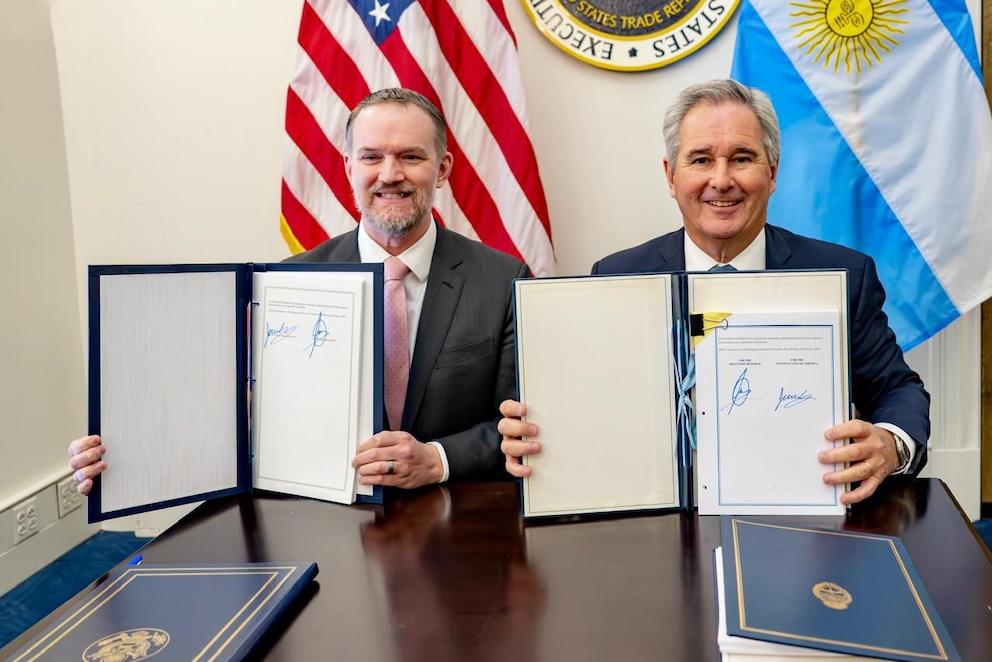
The text released by the chamber highlights that “the agreement promotes a profound modernization of the business climate, through the reduction of non-tariff barriers, the digitalization of processes, the acceptance of international standards and approvals and the simplification of internal procedures.” From the perspective of the entity, these measures “contribute to reducing operating costs, improving competitiveness and facilitating the operations of companies, SMEs and entrepreneurs.”
In addition, AmCham highlighted the emphasis on strategic sectors such as energy, infrastructure, mining, critical minerals and productive investment, as well as the incorporation of labor and environmental commitments, which reinforces a vision of sustainable and inclusive development.From that perspective, “the incorporation of labor and environmental commitments reinforces a vision of sustainable and inclusive development.”
The trade agreement, they added, constitutes an advance in the process of international insertion of Argentina, compatible with the country’s entry into the OECD, and deepens the geopolitical alignment with the United States under Western principles of trade and international relations.The text also mentions that the agreement establishes binding legal obligations, specific compliance schedules and a reciprocity scheme that links the opening of markets with regulatory transparency and national security.
“This agreement represents a strategic opportunity to move towards a more integrated, competitive and federal Argentina, in which trade and investment are pillars of economic and social development,” they evaluated.For the entity, “the construction of clear, predictable rules aligned with international standards constitutes an essential condition for generating trust, attracting investments and promoting productive innovation throughout the country.”
The statement concludes with a call to the National Congress to approve the agreement.“In this context, it is key for the National Congress to accompany its treatment, allowing progress in the implementation of the necessary measures so that these benefits are materialized in an effective and sustainable manner,” the document concludes.

