


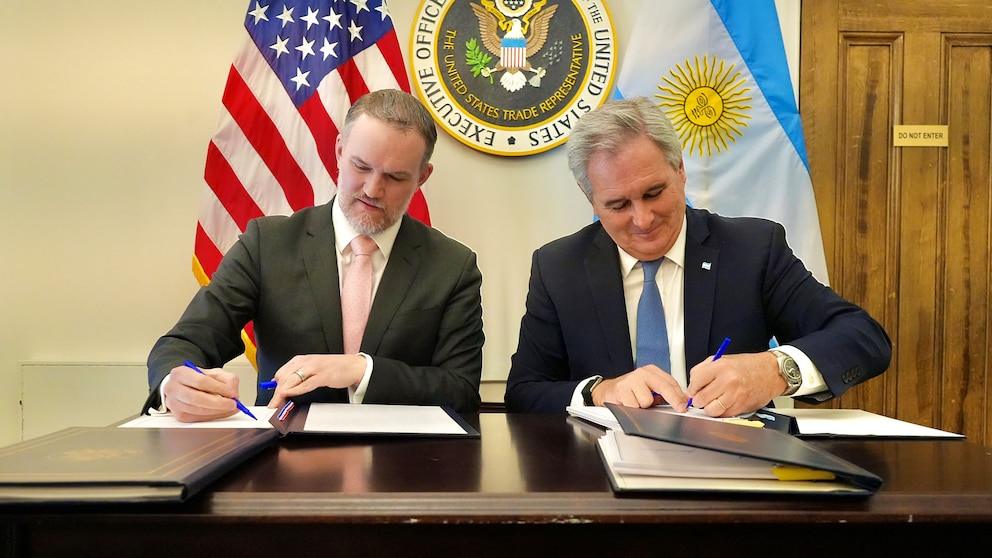
The text of the Agreement on Reciprocal Trade and Investment, which the Office of the United States Trade Representative published on its website yesterday, and which was signed by Argentine Foreign Minister Pablo Quirno and Ambassador Jamieson Greer, does not include among its explicit provisions all the areas that the parties seek to open for bilateral trade.It is, understandably, just a starting point.
The document, which eliminates tariffs for the entry of 1,675 Argentine products to the Northern country and for the arrival of 221 North American products to Argentina, leaves for later sensitive definitions such as the expansion of the export quota for Argentine meat, the definition of improvements for the export of auto parts or an improvement in tariffs for steel and aluminum.
Many of the definitions that the Argentine Foreign Ministry included in the statement are not part of the text, although they are part of the conversations that led to it. Some of them require extra executive actions from the US Government that, depending on the case, are taken for granted and immediate completion is expected or may take time to be defined.
The first point that generated some suspicion among casual observers was the fact that the document eliminates tariffs in the Argentine market for American beef, with quotas, while it does not grant any improvement for Argentine beef in the United States.This is by design.
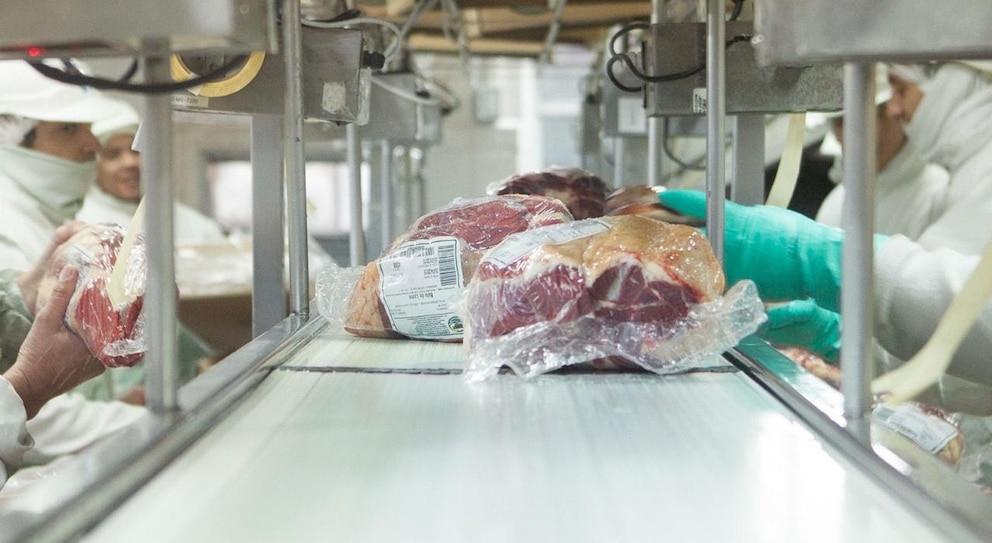
The text of the agreement revolves around tariffs and non-tariff barriers.The extension of the preferential access quota for Argentine beef to 100,000 tons per year (80,000 additional tons above the current 20,000 tons) does not need to be in the text because it is a purely administrative executive action.Both from Washington and Buenos Aires explain that it is a firm commitment that will be resolved administratively as soon as possible.
“On the meat issue we have an unprecedented decision by the United States, where the quota that Argentina had has increased from twenty thousand metric tons per year to one hundred thousand metric tons per year. That is a decision of the United States government directly, which is not included in the agreement. That is an additional benefit that Argentina receives from this agreement and this strategic relationship that we have between the United States and Argentina,” Quirno said last night in television statements.
Curiously,%20a%20of%20the%20points%20m%C3%A1s%20conflictive%20-the%20possibility%20of%20grant%20a%20rebate%20for%20the%20Argentina%20a%20the%20tariffs%20of%2050%%20that%20weigh%20on%20%20steel%20and%20aluminum%20foreign%20that%20punish%20to%20those%20productions%20coming%20from%20all%20theworld%20in%20USA-%20puand%20have%20a%20definition%C3%B3n%20relatively%20r%C3%A1asked.%20The%20Chancellor%C3%ADauses%20a%20formulation%C3%B3n%20ambiguous%20in%20this%20point.%20Barely%20resail%20the%20%E2%80%9Ccommitment%20toreview%E2%80%9D%20this%20%C3%ADtem.%20However,%20in%20Buenos%20Aires%20the%20fe%20is%20blind:%20expectdefinitions%20soon.
It will take more time and work to reduce tariffs for Argentine auto parts, a concern for the local industry.Also, the commitment to investments and financing for strategic sectors requires extra actions that are not fully specified in the published documents.
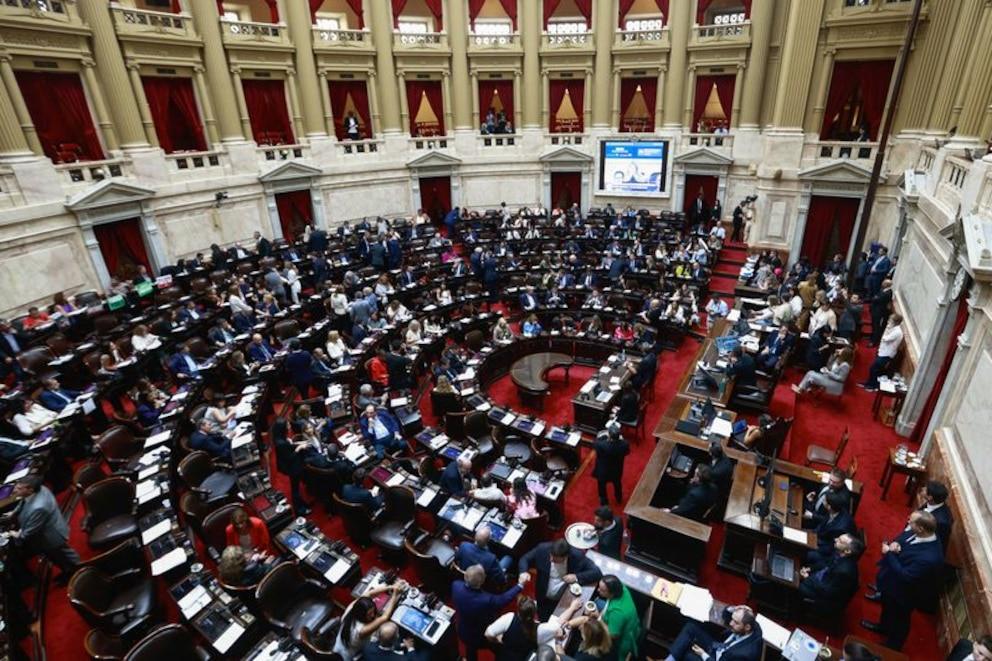
But the parties point out the political relevance of this agreement, a document with a lower legal status than a Free Trade Agreement (FTA), but a milestone in relations between two countries that had never reached this type of understanding.It is seen, from the US, as a sign of strong support from that country for Javier Milei’s efforts to stabilize the Argentine economy and positions the South American country as a trusted partner in the region.
In the business sector and in the national government, meanwhile, they do not hide their enthusiasm for what they believe will be an increase in bilateral trade without damaging the balance that – in an almost unprecedented way – has been registering two years in a row of surpluses favorable to Argentina.
The key is in the tariff differential that Argentina will end up with compared to other economies in the region, mainly Brazil.Experts explain that the unusual Argentine trade surplus in its relationship with the United States is explained – in part – by the distance from Brazil (in addition to the explosion of energy exports from Vaca Muerta).The high tariffs to which the Trump administration subjects Brazil caused some specific productions, not of enormous relevance, to find very advantageous relative conditions.So much so that in some areas Argentina seems to be taking portions of the US market from its neighbor.
“In fact, there are Brazilian companies that are analyzing the possibility of moving part of their chains to Argentina to capture that differential,” Dante Sica, former Minister of Production, head of the consulting firm Abeceb and expert in the Argentine-Brazilian trade relationship, told Infobae.
The dimensions of the growth of trade exchange are not enormous.The official statement speaks of an increase of USD 1,013 million in sales to that country.But they are not minor either if you take into account that last year Argentina sold USD 7.3 billion to the US and the trade surplus was around USD 2.4 billion.
The agreement also leaves a task for Argentina.For example, the country committed to submit to Congress for a vote on adhering to the Patent Cooperation Treaty (PCT) before April 30.Here the vocabulary is key: he promised to present it, not to approve it.Of course, without a doubt, both parties hope for it to be approved.
Also, Argentina must repeal two regulations that make it difficult to protect medicinal and biotechnology patents.There is no date for this nor any difficulties: they are administrative regulations completely within the reach of the Executive Branch.
Expectations are that the US will increase its sales of capital goods to the country. That companies will increase, if they believe this generates more stability, their local investments, especially in critical minerals.The officials faith that this will not break the recent surplus.Because the opening of American meats and other products that appear in the document implies access to non-competitive, non-cheap goods.Think, for example, of Californian wines, Texas meats or American automobiles.All of them are double the value of their local competitors.On the other hand, the potential growth of sectors such as mining, the incorporation of capital goods and the market gain compared to other economies subject to tariffs is what excites Argentine officials.
The concerns, on the business side, include the competition that laboratories will face, to a lesser extent metalworking companies – especially agricultural machines – and the tension regarding the definition of tariffs for steel and aluminum.

